Best Home Computers for Running Coding LLMs Locally in 2026
Buying hardware to run AI models at home can feel like guesswork — vague marketing specs, conflicting forum recommendations, and prices that range from a few hundred dollars to well over ten thousand. This guide cuts through that by focusing on the one number that actually predicts what you can run, then matching it to real machines you can buy today.
Why Memory Is the Real Bottleneck
Running a coding-capable LLM at home used to mean a multi-GPU rig. In 2026, a single well-chosen machine can do it — and the deciding spec isn't raw compute, it's memory capacity and memory bandwidth. That's what actually determines which models fit, and how fast they run once they do.
The budget tier (8GB VRAM): enough for small, genuinely useful coding assistants, but not the models most people mean when they say "run a coding LLM at home."
The sweet spot (24GB class): this is where Qwen3-Coder 30B lives — widely considered the practical baseline for serious local coding work in 2026, delivering 80–90% of what was flagship-level performance just months earlier.
Mini-PCs Built Specifically for This
AMD's Ryzen AI Max+ 395 ("Strix Halo") platform is the standout here. The reference design — AMD's own Ryzen AI Halo Developer Platform — ships with 128GB of LPDDR5X-8000 unified memory, a 16-core Zen 5 CPU, integrated Radeon 8060S graphics, and a 50 TOPS NPU, in a 149mm cube, for $3,999. The same silicon shows up in consumer mini-PCs from Framework (Framework Desktop) and Minisforum (AI370), and a higher-memory variant — the Ryzen AI Max+ PRO 495, supporting up to 192GB and reportedly capable of running 300-billion-parameter models — is expected later in 2026. At the 64GB-class tier, this hardware comfortably handles larger models like Qwen3-Coder-Next.
Apple Silicon, If You Want It Quiet
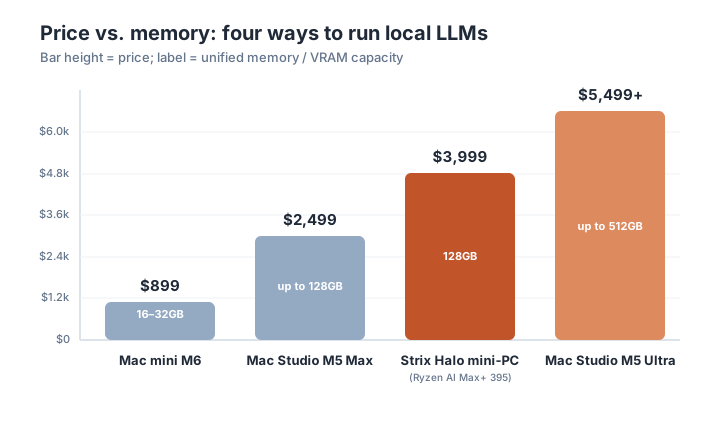
The 2026 Mac lineup spans a wide range. A Mac mini (M6, $899) gets you in the door but caps out around 16–32GB of shared memory — fine for small models, not for serious coding LLMs. Step up to a Mac Studio (M5 Max, $2,499) and you're in genuinely useful territory; unified memory means even relatively affordable Macs can run 33B-class models that won't fit on most consumer GPUs at any price. At the top, the Mac Studio M5 Ultra ($5,499 and up) supports up to 512GB of unified memory at 1.2TB/s of bandwidth — reportedly the first desktop under $11,000 able to run frontier-scale open models entirely locally, no cloud involved.
Price versus unified memory across four local-LLM machines
Head-to-Head
Machine
Price
Memory
Bandwidth
Mac mini M6
$899
16–32GB
170GB/s
Mac Studio M5 Max
$2,499
up to 128GB
—
Strix Halo mini-PC
$3,999
128GB
—
Mac Studio M5 Ultra
$5,499+
up to 512GB
1.2TB/s
Verdict
For most people, a 24GB-class GPU or a $3,999 Strix Halo mini-PC will comfortably run a genuinely capable coding model like Qwen3-Coder 30B — that's the sweet spot for price-to-capability. Only reach for a $5,499+ Mac Studio Ultra if you specifically want to run the largest open-weight models entirely on your own hardware; anything less than that and cloud APIs remain more cost-effective than the hardware to replace them.