Open-Weight LLMs in 2026: How Close Are They to GPT-5 and Claude?
For most of 2025, choosing between an open-weight model and a paid API meant a real trade-off: pay for the best results, or accept a noticeable capability gap to save money and keep control over your own data and infrastructure. That gap has narrowed dramatically heading into 2026 — narrow enough that it's worth a proper, model-by-model look at where things actually stand today.
The Current Leaderboard
Open-weight models have closed most of the gap with proprietary frontier AI in 2026 — and on a few specific benchmarks, they've pulled ahead entirely.
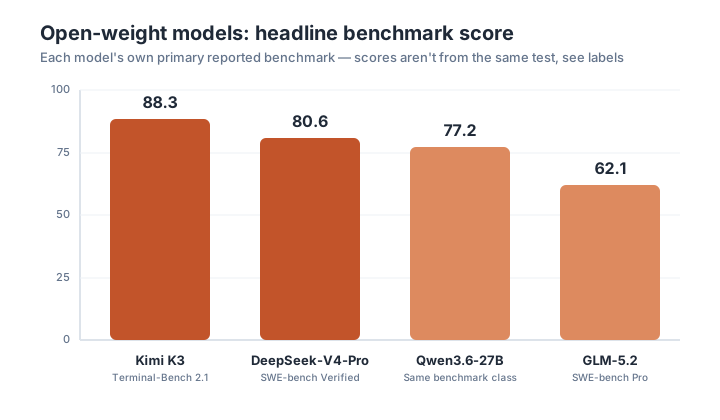
Kimi K3 is currently the strongest open-weight model overall: 88.3 on Terminal-Bench 2.1, 81.2 on FrontierSWE. It's a huge mixture-of-experts model — 2.8 trillion total parameters, only 104 billion active per forward pass — with a 1 million token context window.
If licensing matters to you, GLM-5.2 is the strongest fully MIT-licensed option, hitting 62.1% on SWE-bench Pro and reportedly the first open-weight model to beat GPT-5.5 on that benchmark. DeepSeek-V4-Pro is close behind at 80.6% on SWE-bench Verified, also MIT-licensed, with a 1.6-trillion-parameter mixture-of-experts architecture, a 1M-token context window, and a new Hybrid Attention design that makes it comparatively efficient to actually serve.
For anyone without a datacenter, Qwen3.6-27B is worth knowing: a dense 27B model reaching 77.2% on the same class of benchmarks — small enough to run on a single high-end GPU or a well-specced local machine. Open-weight models compared on their headline benchmark score
At a Glance
Model
Parameters
Headline score
Context window
License
Kimi K3
2.8T (104B active)
88.3 (Terminal-Bench 2.1)
1M tokens
Open-weight
DeepSeek-V4-Pro
1.6T (MoE)
80.6% (SWE-bench Verified)
1M tokens
MIT
Qwen3.6-27B
27B (dense)
77.2%
—
Open-weight
GLM-5.2
—
62.1% (SWE-bench Pro)
1M tokens
MIT
How Close Is "Close"?
Closer than most people expect. The remaining gap between the best open-weight models and proprietary frontier systems like GPT-5.x, Claude, and Gemini is now mostly about polish — instruction-following nuance, multimodal handling, very long-context reliability — rather than raw coding or reasoning capability. On several individual benchmarks, open models sit within a few points of the frontier; on some, they're already ahead.
Why It Matters
Open-weight models can be self-hosted, fine-tuned, and run without per-token API billing. That's exactly why the next two questions worth asking are how much a paid API actually costs you day to day, and what it would take to run one of these models yourself.
Verdict
If you need the absolute best coding performance available today and don't mind API billing, proprietary frontier models still have a slight edge. But if licensing flexibility, self-hosting, or avoiding per-token costs matter to you, Kimi K3, DeepSeek-V4-Pro, and GLM-5.2 are now genuinely competitive — not "good enough," but close enough that the choice increasingly comes down to deployment preferences rather than a capability gap. #opensourceai#llm#aimodels#machinelearning