The Most Cost-Efficient LLMs for Coding in 2026, Ranked
Every coding assistant on the market claims to be the smart choice for your budget, but the marketing rarely matches the actual per-token numbers. Below is a practical breakdown of what things really cost in 2026 — from the cheapest options that still hold up on real benchmarks, to the frontier models worth paying a premium for when the task demands it.
The Value Leaders
If you're paying per token for AI coding help, the difference between models isn't just quality — it's often a 10x swing in cost for comparable results.
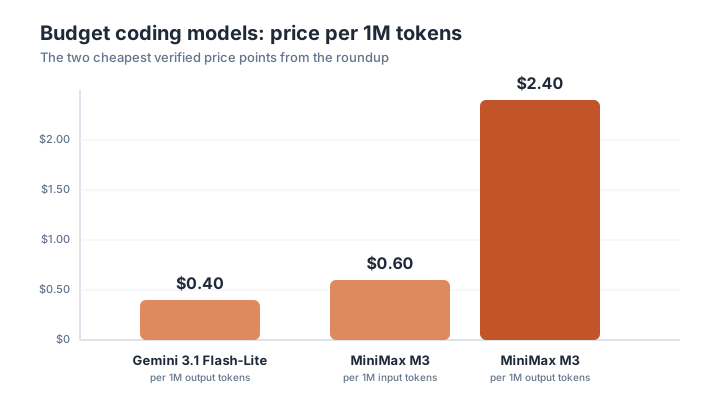
Best raw value:Gemini 3.1 Flash-Lite currently dominates on pure cost-efficiency, at around $0.40 per million output tokens, while staying genuinely useful for everyday coding tasks. For teams running high volumes of agentic coding sessions, Gemini 3.1 Pro is the pick — strong performance at a cost-efficient price point built for scale.
Best performance-per-dollar among serious coding models:DeepSeek Coder 2.0 leads here — it isn't the cheapest model available, but per dollar spent, it delivers the best coding results of anything tested. DeepSeek V4 is the budget-friendly sibling worth reaching for on cost-sensitive workloads, and DeepSeek V4 Pro costs roughly a tenth of flagship pricing while staying credible on real-world coding tasks.
Cheapest model that's still genuinely capable:MiniMax M3 is the cheapest model to score above 80% on SWE-bench Verified, priced at around $0.60 input / $2.40 output per million tokens — a real option if you need dependable results without flagship pricing.
Verified pricing for the two cheapest models in this roundup
Quick Price Comparison
Model
Input ($/1M)
Output ($/1M)
Best for
Gemini 3.1 Flash-Lite
—
$0.40
Routine completions, boilerplate
MiniMax M3
$0.60
$2.40
Reliable results, 80%+ SWE-bench
DeepSeek V4
low
low
Cost-sensitive workloads
DeepSeek Coder 2.0
mid
mid
Best result-per-dollar
Claude Sonnet 5
high
high
Best value among frontier models
When Budget Isn't the Constraint
GPT-5.6 Sol currently ranks as the strongest coding model overall, with Claude Opus 5 close behind for large, complex projects. Claude Sonnet 5 is the best value pick within Anthropic's lineup — noticeably cheaper than Opus with only a modest capability trade-off.
Best open-weight coding model:GLM-5.2 — a 1M-token context window and, notably, the first open-weight model reported to beat GPT-5.5 on SWE-bench Pro. Since it's open-weight, you can also self-host it, which changes the cost equation entirely.
Verdict
Match the model to the task, not the leaderboard. Flash-Lite or DeepSeek V4 for routine completions and boilerplate, DeepSeek Coder 2.0 or MiniMax M3 when you need reliable results without flagship pricing, and Opus 5 or GPT-5.6 Sol only when a task genuinely needs frontier-level reasoning. Most coding work — realistically — falls into the first two categories, which means most teams are almost certainly overpaying.